
They couldn’t.
As others answers note, by this point in the war, Japan was low on fuel, planes, and pilots. This means they had to be judicious with their use.
Shooting down a B29 was a different story from shooting down B17s and B24s in Europe. They flew higher and faster. Indeed, the B29 had a comparable speed to many contemporary fighters when cruising at high altitude. There is a reason the B29 was alleged to be more expensive than the Atomic bomb. It wasn’t just the size and range of the plane, but it’s overall performance.
For a Japanese interceptor, this creates problems. They would need to detect incoming bombers early enough to dispatch the fighters, and anticipate where in the sky they were going.
A fighter plane cannot fly forever at maximum performance, and doing so could put wear and tear on the engines, something Japan was increasingly less able to replace. This means that not only could they not race up to altitude to engage the bombers, but that even when they were up at the bomber’s altitude, they only had a limited window to engage at high performance. They could not afford to chase the bombers across the sky.
This was exasperated by the fact that Japan’s radar technology lagged significantly behind the other major combatant nations. I suspect that by the time Japan actually detected many B29 formations, it was too late to actually send fighters up after them.
There was just no way they could waste the fuel, planes, and ammunition to chase down every B29 they spotted, especially considering that conventional bombing raids were still taking place across Japan. Chasing a few reconnaissance flights might have meant not being ready or available when another 300 plane raid approached a major city.
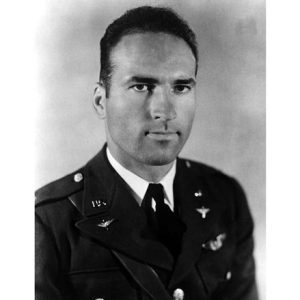
Colonel Paul Tibbets was in command of the 509th Composite Group, the unit charged with attacking Japanese cities with the atomic bomb. He was a very detail oriented guy. He gave a lot of thought to the bombing mission.
The Japanese were used to seeing a hundred B-29s on a raid. With the atomic bomb, only three Silverplate B-29s would actually be in the vicinity of the target. Tibbets had options including escorting those three bombers. He decided to run some tests. He sent out flights of two and three B-29s to fly near Japanese cities at 30,000 feet. The Japanese, short of aviation fuel, ignored them, assuming they were reconnaissance flights. That told Tibbets what he needed to know.
On August 6, 1945, the Enola Gay. the strike plane carrying Little Boy, The Great Artiste, the observation/instrument plane, and Necessary Evil, the camera plane, arrived over Hiroshima, and the rest is history.
Why didn’t Japan shoot down the US plane carrying the second atomic bomb for Nagasaki even after what happened at Hiroshima?
A better question is why did Tibbets use the same tactic on the second atomic bomb mission? Nobody knows. There has never been anything written on the subject. In post-war interviews with Tibbets, the subject never came up. My guess is that Tibbets thought through the issue and decided the Japanese hadn’t had time, after only three days, to develop a defense to this new threat.
There was a third atomic bomb. Another good question is, “Would Tibbets have used the same tactic later in August for the third mission?”
The Silverplate B-29s only had a tail gunner with 50 caliber machineguns.
There were a total of seven Silverplate B-29s on the Hiroshima mission and six on the Nagasaki mission.