The Rocky Mountains are the biggest geological feature in North America, and they don’t behave like any other mountains.
Buckle up. This is a pretty good geologic detective story, and it goes all over the western United States.
What makes the Rockies unusual?
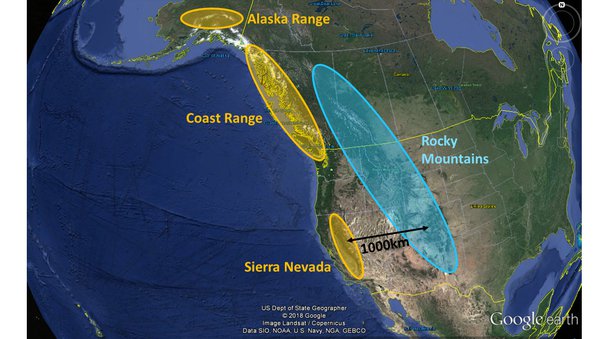
The Rocky Mountains are part of a chain of mountains called the North American Cordillera. The chain stretches around the Pacific from the ice caps of Alaska to the high deserts of Arizona.
The Pacific Ocean has been friendly to mountains for a long time. It’s ringed by plate boundaries. The ocean floor, or crust, pushes hard against the coasts of Alaska, Japan and South America.
The Pacific used to push against the coast of the western United States, too. This push lasted from 165–55 million years before the present. The coast buckled, forming the Sierra Nevada.
This is all geologically sensible. The oceanic plate pushes into the land, and coastal mountains go up. That’s a standard convergent plate boundary.
It doesn’t explain why the highest parts of the Rocky Mountains are more than 1000 km away from the plate boundary.
Are the Rockies on an old plate boundary?
Most of the other answers to this question have suggested that the Rockies were formed on an old plate boundary. This is not true.
The parts of the US that are made from colliding plates — such as California — are made from accreted terranes. This is a geologic term meaning “lots of little islands, mostly volcanic, all mashed together by big collisions.”
The Rocky Mountains, in contrast, are not mashed at all. They are formed from a continuous series of sedimentary rocks, such as mudstones and sandstones. These rocks were laid down on an ancient coastline that stretched from modern-day New Mexico to Canada.
Here are these areas on a (colorful, chaotic) geologic map of North America:
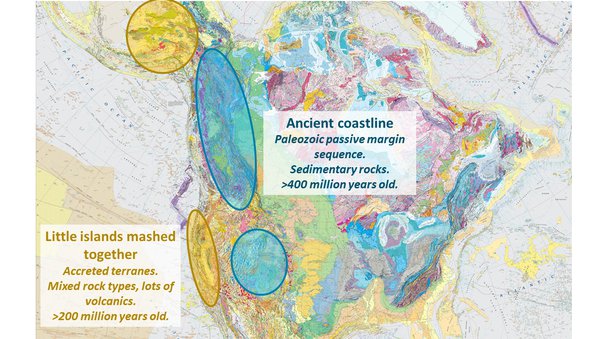
[Figure correction: The accreted terranes (yellow) are all younger, not older, than 200 million years]
What happened, exactly?
The rocks that make the Rockies:
- Were laid down at sea level (500 million years ago)
- Sat quietly for 400 million years.
- On the west coast, plates collided and mountains grew. The Rockies were 1000 km away, and did nothing.
- Jumped 4000 m+ in the air and became the Rocky Mountains.
That’s not normal plate boundary behavior.
So why did the Rockies grow?
To make the Rockies grow, you have to take the force from the coastal collision and transmit it 1000 km inland.
You can’t do this on the surface – the rocks are too weak.
The best idea we have, at present, is that the force was transmitted under the surface through a piece of cold, hard oceanic plate.
Usually, when a piece of oceanic crust hits a continent, it sinks quickly into the hot, weak asthenosphere below. This is normal-angle subduction.
In the case of the Rocky Mountains, we believe that the oceanic plate floated.
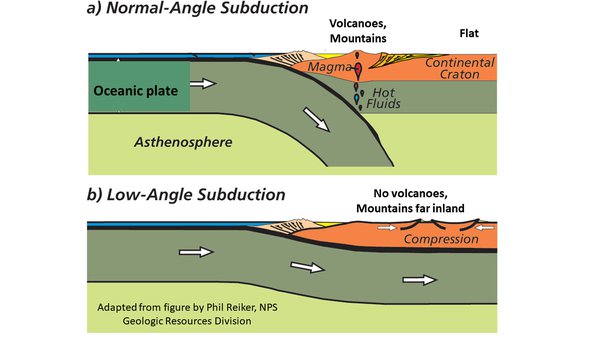
It stayed pressed against the continental plate, and transmitted mountain-building force far inland.