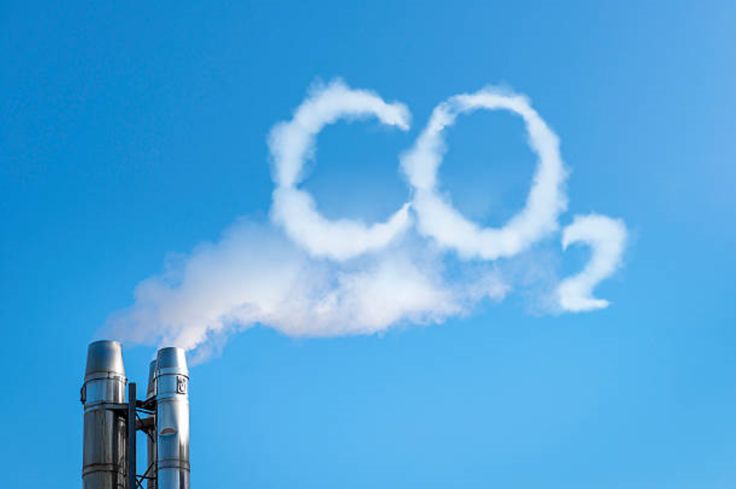
The molecular weight of air is about 30 and CO2 is about 44 so there’s not a large difference. The air stays mixed due to convection and gaseous diffusion and its composition stays fairly constant up to an altitude of about 100km.
The Ozone layer is the exception at about 20–30km where Ozone is created by absorption of UV light from the sun by oxygen, due to its short life time it doesn’t mix with the lower altitudes before it breaks down. Occasionally CO2 can be generated in high concentrations around volcanic areas and form dangerous concentrations locally before it can be mixed.
OK welcome to basic gas laws and chemistry class. CO2 has a molecular weight of 44.01 g/mol. Oxygen has a molecular weight of 31.998 g/mole. Nitrogen has 28.0134 g/mol. 39.948 g/mol is argon.
Our atmosphere gases form in most cases essentially an IONIC mixture of Nitrogen, Oxygen and Argon. There is so little CO2 as to be irrelevant to this math and situation. CO2 mixes Ionically with the air. This means it is in solution. Just like salt and water stay together (generally) and don’t separate CO2 generally does not separate in the air. ——- The Ionic feature is the product of water in the air.
Now if the release is very high into the air CO2 can collect temporarily. I have been in a valley below the Nisqually Glacier on Mt. Rainier in Washington State in the USA where there were locations marked off by signs to avoid CO2 because it can kill you. But that is a lot of CO2 coming up. It fairly quickly mixes in the air and goes away.
As such the atmosphere is pretty much a well-mixed mixture of the gases. CO2 is so rare it really doesn’t matter. It is 0.042% at this time. Don’t imagine this is a significant constituent of the atmosphere. A crowded hall with people may see it go up to 0.250% just from people breathing. In enclosed environments people without problems see it go as high as 5%.
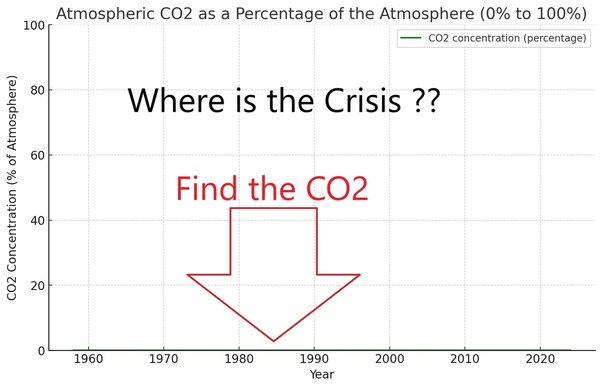
CO2 does slightly settle downward in the atmosphere. By the time you get to the top of a very high mountain, the CO2 is so low in the air that plants often don’t survive. CO2 is restricted in any quantity at this time to about 12,000 feet elevation.
It is detectable above that level but the percentage drops to about 0.015% and plants stop reproducing and etc at that level. The increase in CO2 in the atmosphere over the past years has raised this 12,000-foot elevation up from about 8,500 feet when I was young.
No spots on earth even the lowest in the Dead Sea region see the percentage go up much at all!
CO2 is not dangerous below about 6% and has geologically been as high as 1% when it formed most of the life on earth in all history. CO2 is the most essential chemical on earth for life! Without CO2 there is no life. You would have no food to eat if there was no CO2.