In 1942, as the British readied airfields for them, B-17 bombers and P-38 twin engine fighters would self deploy from the US to England. Neither aircraft had the range to go in a single “hop”. What the US did was to setup a series of refueling stations along the route. Each aircraft took about a week to make the multiple hops necessary. This was known officially as “Operation Bolero”.
Operation Bolero – Wikipedia
US military building up in the UK in WWII Major General Henry H. Arnold . Operation Bolero was the commonly used reference for the code name of the United States military troop buildup in the United Kingdom during World War II in preparation for the initial cross-channel invasion plan known as Operation Roundup , to be implemented in mid-1943.
Also for its lesser contingency alternative, Operation Sledgehammer , to be executed in the fall of 1942 in the event of German setbacks or to ease Axis pressure on the Eastern Front . (“Bolero” was the code name used in official communications to stand in for “United Kingdom” when describing the theater or movements.) What later became the Bolero plan – the buildup of a strategic air force in the United Kingdom, in preparation for Roundup – was first submitted by Commanding General of the U.S. Army Air Forces , Henry H. Arnold , to General George Marshall , the U.S. Army Chief of Staff , on April 12, 1942, and set in motion a huge movement of men and material that laid the groundwork for Operation Overlord .
To complement the Roundup invasion plan, planning for the movement and basing of U.S. forces in the United Kingdom was begun at the end of April 1942 and given the code name of Bolero. A combined committee of key British and American logistical officers worked in both Washington, D.C. , and London planning the build-up, to co-ordinate the effort on the highest level.
On 5 May 1942, Gen. George Marshall and Commanding General, Services of Supply , Lt. Gen. Brehon B. Somervell named Major General John C. H. Lee as Commanding General, Services of Supply, U.S. Army Forces, British Isles. Lee would spend two weeks in Washington on initial planning and key staff, and then fly to England to build the operation, and begin work on the hundreds of bases, airfields, warehouses, depots, hospitals, and storage tanks that would support the 3 million U.S. military personnel eventually coming overseas.
In May 1942, with a tentative target date for Roundup of April 1943, the Operations Division of the War Department and USAAF Headquarters drafted plans to transport and house a million American troops: 525,000 ground troops, 240,000 air force troops, and 235,000 from Services of Supply.
Arnold’s plan to Marshall called for the basing by April 1, 1943, of 21 heavy bomb groups ( B-17 and B-24 ), 8 medium bomb groups ( B-26 and B-25 ), 9 light bomb groups ( A-20 ), 17 fighter groups ( P-38 , P-39 , P-40 , and P-47 ), 6 observation groups, and 8 transport groups—a total of 69 combat groups plus their service units. General Arnold met with RAF Air Chief Marshal Charles Portal at the end of May 1942 and presented the U.S. schedule for the arrival of U.S. Army Air Forces into the theater by March 1943, totalling 3,649 aircraft. The proposed build-up anticipated 15 groups in July, 35 by November and 66 by March, excluding observation squadrons. Arnold anticipated that by the April 1 deadline, the combat units of the Eighth Ai
Operation Bolero, was the self-deployment of B-17 and P-38 to England via “stepping stones”. What follows is a transcript from the War Diary of W. S. Arnett, 1st Lt, USAAF. He was part of the 301st Bombardment Group Heavy (which means 4-engine B-17s instead of 2-engine B-25s). His Operation Bolero self-deployment began July 21, 1942 in Presque Isle, Maine, and ended a week later, July 28, 1942 at their Final Destination, a new airfield in Bovingdon, England.
Another online copy of the War diary of Will Seaton Arnett at reddog1944
============================
Getting There
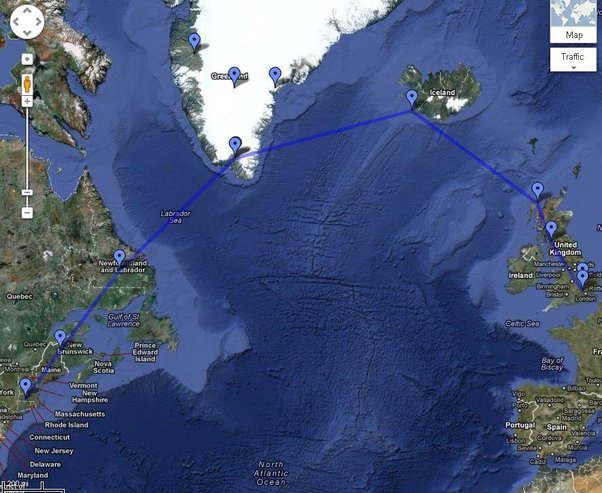
July 21, 1942 Presque Isle, Maine
Arrived 12 A.M. Left Westover Field, Mass. at 9:30 A.M. This is a God Forsaken country, but still in the U.S. Nothing but rolling hills and potato Farms. Initiated “Short Snorter” at the Officer Club.
July 22, 1942 Labrador
Departed from Presque Isle at 12:30 P.M. Arrived here at Goose Bay at 4:00 P.M. This is really a “Hell Hole” Doesn’t get dark until 10:30 and not complete darkness then. Climate is pleasant. Attended briefing at 9:00 until 10:30.
July 23, 1942 B W I Greenland
Departed from Goose Bay, arrived here 4:30 P.M. Came across the North Atlantic. Saw my first Icebergs off the coast of Labrador, but they are much larger here. This is at the mouth of a Fjord about 52 miles inland and as far a man can go. Greenland is a solid mass of ice except right on the edges. It never gets dark in the summer months, just like the books say. The sun stays up about 16 hours. After it disappears it becomes twilight and is much lighter than a full moonlight
July 24, 1942 B W I Greenland
Another day and would-be night on Eskimo Island. If we stay here much longer I will die of hunger, the food is terrible and accommodations are even worse. We were supposed to have left today, hope to get out tomorrow.
July 25, 1942 Patterson Field, Iceland – near Reykjavik
I’ve seen everything now. Departed from BWI 9:30 A.M. Arrive here 2:00 P.M. We are on the southern tip of Iceland which seems to have been built up by a volcanic eruption because of the formation of the rocks and the texture of the soil. The wind has a normal velocity of about 30 MPH and is pretty cold. We are living in so-called huts built of sheet metal in an oval shape about 15′ by 35′. They are very comfortable and are heated by native coal which is harder than any I’ve ever seen. I had the first decent meal I’ve had since I left Westover Field. This is the first time we have been treated like white men. The Officers Club is real nice and has a bar with American made beverages. We haven’t been allowed to leave the limits of any of the posts we’ve been on so far. There has been no place to go up till now. I’d like to see if 95% of the Danish (Icelandic to them) are all blondes — especially the female sex. The trip today was very pleasant — the weather was fine and smooth. One element was fired upon by two enemy subs about 300 miles out but no damage was done. It’s luck for the subs that we weren’t loaded with depth chargers because they would have never fired at anyone else. The sun didn’t go down in Greenland yesterday until 11:30 P.M. and it was up again at 5:30. It doesn’t do the good here. I shaved for the first time I 4 days today and left my mustache — the first one I’ve ever tried to grow.
July 26, 1942
Reykjavik Iceland. Moved from Patterson field this morning. The living quarters are the same. Went into town this afternoon and it was very interesting. This being Sunday everything was closed. The only thing open was one bakery and a theater. The people here are very religious and unfriendly, especially the girls, they won’t talk to you at all on the streets, in fact, I saw very very few on the streets at all. The girl in the bakery informed us that the Icelandic girls preferred the English boys to the Americans. She said that the girls who danced with American soldiers were considered bad. Most of them can speak English well, they learned it from the English sailors. Saw the statue of Lief Erikson, the real discoverer of America. 95% of the Icelandic people are blonds. In bed at 10:15 and the sun is still an hour up.
July 27, 1942 Prestwick, Scotland
Left Reykjavick this morning and stopped at Stornaway on the Island of Lewis to let the P38 pilots rest. We saw a number of ships partially sunk, also two subs following a battle ship. Believe it or not this is war and can certainly tell it.
We arrived here at 5:00 P.M and had dinner then arranged for quarters. I thought I’d seen everything but this place takes the cake. The people are so backward it is pitiful. This seems to have been a wealthy place at one time. The homes and buildings are just like the pictures. The streets are narrow and very crooked. bicycles are the main means of transportation. There are very few cars the and traffic is left-handed. The busses are two deckers and very old. Scotland is almost as far north as BWI in Greenland- so it is pretty cold. I’m staying in what used to be a home, but was taken over by the government for their Army. The people of Scotland are very friendly and their language is unusually strange and hard to understand. It’s amusing to listen to them talk.
July 28, 1942 Final Destination – Bovingdon, England
It’s wonderful to know that we are actually going to stay in one place long enough to learn what it’s all about. This is certainly beautiful country from the air. We arrived here at 5:30 P.M. This is a new field and was turned over to the U.S. Army for a training and Combat station. We will operate out of here. The post is somewhat scattered because of the possibilities of attacks. We walk 1/4 mile to the showers and latrine, the club is situated close to the showers. We have private rooms with a coal stove, a dresser and a high single bed with a round straw pillow.
The trip all the way was very interesting and we were extremely lucky to have good weather.
We left Westover Field, Mass. a week ago this morning. All our planes and P38’s got through except three. Had to leave two at BWI and two at Prestwick for repairs. They will be on later. We were the first squadron to get through without losing a plane.
Route map for the initial stages of Operation Bolero.
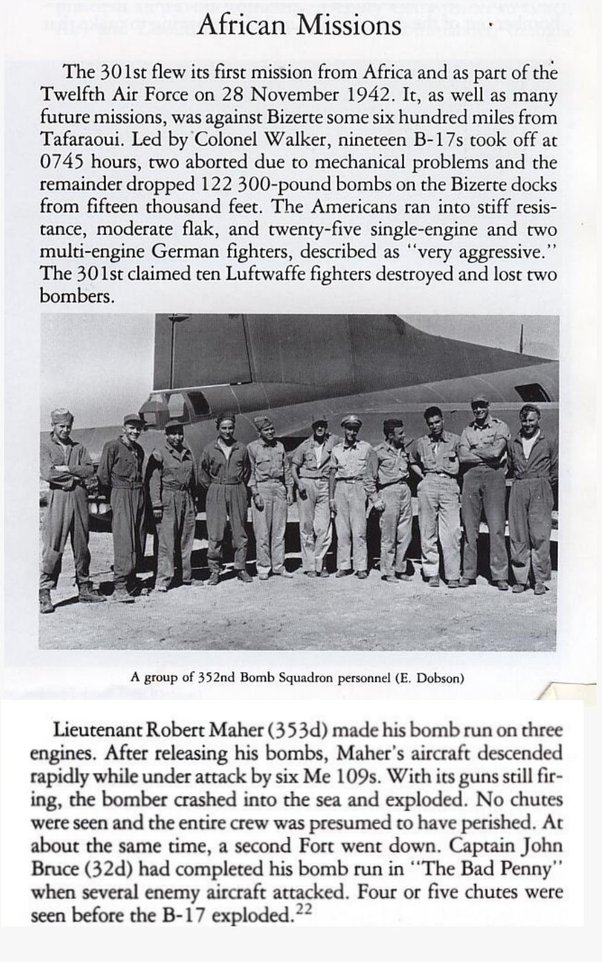
I originally collected this information, because my mother’s 1st cousin was also in the 301st BG (353rd squadron), Tech Sargent Frank Conlon, B-17 radio operator. Later in Lt. Will Arnett’s diary, he states: “November 28, 1942 Tafaroui, Africa. Just got back from an eight hour bombing mission on Bizerte, Africa. Up at 4:30 — breakfast to 5:00 — briefing at 5:30 — take off 8:00, over the target 11:30, and landed at the base at 4:00 P.M. No. 1 classmate “Toby” was shot down and the plane exploded when it hit the water. Toby was co-pilot of (my first cousin once removed) T/Sgt Frank Conlon’s B-17. As their aircraft was also the first one lost after deployment to Africa to support the Allied invasion there (“Operation Torch”), this loss was also written about in the 301st’s Group History “Who Fears”. Frank Conlon’s B-17F: 41–24374 was piloted by Lt. Maher.