Titan has some advantages over Mars, that potentially can make Titan a better alternative for human colonization.
The Titan advantage:
- Titan has a thick atmosphere made primarily of nitrogen. The pressure at the surface is about 1.45 times Earth’s atmospheric pressure. The Martian atmosphere, on the other hand, is very thin. It is less than 1% of Earth’s atmospheric pressure at sea level, and is composed primarily of carbon dioxide. Titan’s thicker atmosphere has a number of advantages:
- Airlocks are a lot simpler to design. The pressure inside a craft or a habitat can be equal to the pressure outside. The main thing you’ll need to worry about is the cold.
- And … you don’t need to worry much about pressurizing your habitat or EVA suit. You also don’t need to worry too much about air leaks (a little extra nitrogen is harmless and humans can live a normal life at 1.45 atmospheric pressure).
- The combination of low gravity (14% of Earth) and thick atmosphere means that air travel will be very easy to implement. Winged aeroplanes and zeppelins will work on Titan even better than on Earth. (Using electricity, as there is no free oxygen.) With artificial wings, humans can fly on Titan using their own muscle power. How cool is that?
- Titan gets much lower radiation. It has less galactic cosmic radiation because of the protection of Saturn’s magnetic field, and Titan’s thick atmosphere. Titan gets less powerful solar flares due to its distance from the sun. The lower radiation means people can live on Titan’s surface for as long as they want, unlike the limited duration that Martian colonists can spend on the Martian surface. On Mars, colonists will have to hide under the surface most of their lives to protect themselves from radiation.
- Titan has more water, hydrocarbons and nitrogen. Minerals important to support life. A large percentage of Titan’s surface is made of solid water ice. Titan may have liquid water under the surface.
- Titan is close to other moons, such as Enceladus, that may host life.
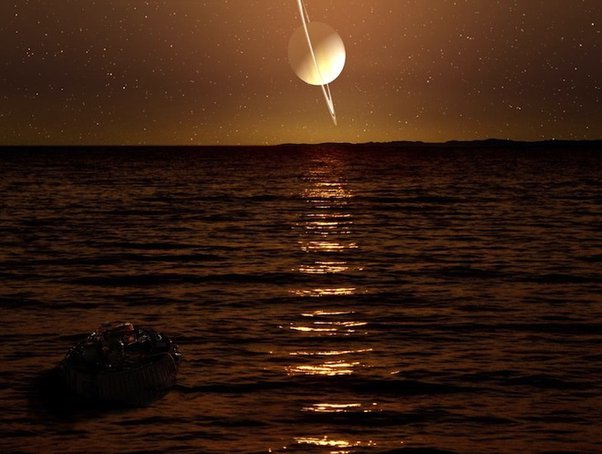
- Titan has nicer scenery. It’s the only celestial body with liquid lakes. If you chose to live in the upper atmosphere, in a zeppelin or a city supported by hydrogen balloons, you’ll be able to see Saturn. (Hydrogen balloons will be safe because Titan has no free oxygen, so no risk of fire.)
The Mars advantages:
- Mars is much closer to Earth. Using the most fuel efficient trajectory, a voyage to Mars will take 7 month, while a voyage to Titan will take 7 years. (This may not be a problem if using better engines such as ion, plasma or atomic drives).
- A Martian day is just over 24 hours. More suitable to our biology. Titan’s day is just over 15 Earth days.
- Mars is closer to the sun, about 1.6AU, compared to Titan’s 9.6AU. That means that on Mars you can still use solar panels. Titan gets only 2% of the solar energy we get on Earth in the upper atmosphere, and less than 1% on the surface. On Titan, solar panels are not a viable option and we will have to use nuclear reactors.
- The Martian gravity is about 0.376g compared to Titan’s 0.14g. Mars’ stronger gravity is more suitable for our biology.
- Mars is warmer than Titan, with an average of -63° Celsius rather than -170° Celsius.
Honestly, I see Mars being colonized before Titan, primarily because of the distance and more so because of public interests. But Titan is way cooler and not entirely a bad alternative.
Note: Many of the stories of my science fiction collection Escape Velocity, take place on Titan.

Although Titan may be a good candidate for colony missions far into the future, Mars is still a far better candidate, for a few reasons.
- Titan is far away.
- Honestly, this one should be kind of a given. Saturn is 1.2 billion kilometers away at its closest, whereas Mars is only 54.6 million kilometers. That’s a pretty big difference, and it’s one of the main reasons Mars is our first goal: it’s relatively easy to supply compared to Titan.
- Titan is fucking cold.
- Like, not Antarctica cold. More like liquefying methane kind of cold. The temperature on Titan is 93 Kelvin, which is also the only way Titan’s temperature can be measured with a positive number. 93 Kelvin is Equivalent to -179.5* Celsius. That’s really, really fricking cold. In contrast, Mars temperature averages out around -60* C, a far cry from Titan’s frozen Hell.
- Titan is really, really dark.
- Here’s the general thing about colonies: they need electricity to function. Without electricity you have no communication, no water, no heat, etc. And what’s the #1 way space colonies are going to generate electricity? Solar power. So what is needed in order to establish a successful colony? Light. And it doesn’t help that Titan’s surface only receives around 0.1% of the light that Earth receives, both due to the distance from the Sun, and the thickness of the moon’s atmosphere. Which makes Mars’ 44% of Earth’s light very, very appealing.
At the end of the day, Mars is closer, warmer, and more suitable for life than Titan, even if we have to live underground to hide from the solar radiation. It’s cheaper and easier, and trust me, when you’re building a space colony, you’ll want all the cheap and easy you can get!