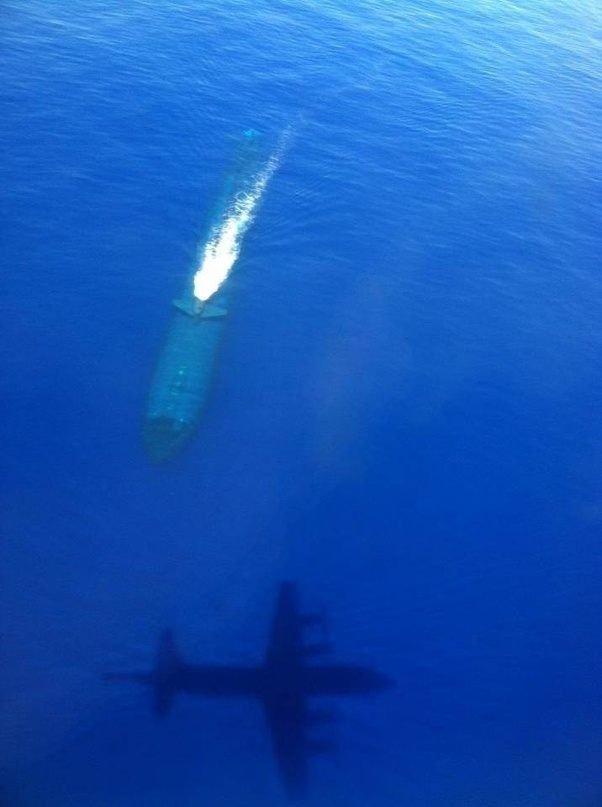
This is a great picture of an LA class sub with the shadow of a US Navy P-3 in the foreground. These seas look to be the most tranquil and the correct blue to see pretty far down. This ship is at PD, periscope depth (notice the wake of the scope), so her deck is approximately 20 ft below the surface. This sub is also speeding, going much faster than required at PD to create the wake, possibly so the P-3 could find her in the first place.
Most of the oceans are much darker and rougher and seeing below the surface is almost impossible… I recall many more times where the airplanes couldn’t find us than when they could.
Trust me; this really IS about how deep submarines need to be to not be “seen” from the sky by airplanes.
BTW, planes can’t see, but if you put some sophisticated electronic equipment on them, with a trained operator, they can “see” pretty well, and pretty DEEP too!
When I was 22, and had my 37-foot sailboat in Half Moon Bay, California, I was approached by a fellow who wanted me to deliver “a cardboard box” from Central America to San Francisco in my boat. “Box man” was going to pay me $25,000 for this, which was two year’s wages at the time.
Because I knew what he was talking about, I wasn’t tempted, even for a moment. I knew that guns and violence went along with that “little cardboard box”, and that people had gotten killed for far less. I had my little boat paid for, and was getting ready to go on a world cruise.
At 24 years old, I’d decided I was going to retire first, sail around the world, then get serious and have a career and a family. No way I was going to risk that bright future for a stupid box.
And fortunately, to lend technical support to my ethical and moral committments, I’d gone to the bar before I talked to “box man”. That would be the little bar in Mountain View, California, just down the street from the Moffett Naval Air Station. While I had my beer, I’d sat next to a guy who was a crewman on a P3 Orion Subchaser aircraft, based at Moffett Field, just across the highway from the bar.
(Below) An Orion P3 with a full load of Harpoon anti-ship missiles, plus torpedoes up inside the aircraft’s hull where you can’t seen them.
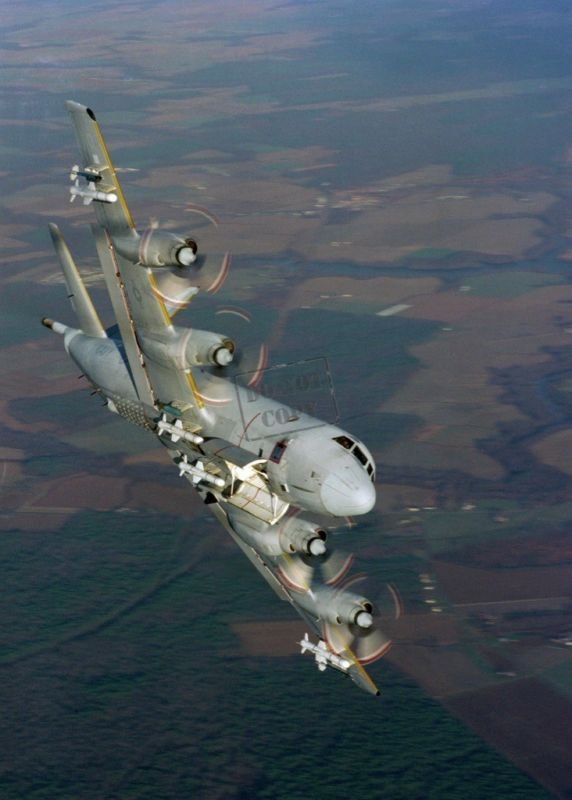
(Below) A close-up of the Orion’s wingtip; it also carries AIM 9 Sidewinder air-to-air missiles in case it needs to defend itself against other aircraft.
We got to talking, he found I had a sailboat, and he started talking about where they flew and the detection and tracking capabilities of the aircraft. I love planes, and was very interested in anything involving boats, ships, or the ocean, so of course I was a good listener.
The gear they had on the P3 aircraft was capable of detecting two whales 500 feet under the surface of the ocean; and he said they could tell which one was the mother whale and which one was the baby. He went on to describe how they routinely tracked drug trafficker’s boats on the trip up from Mexico; for a boat on the surface was easy for these aircraft to keep track of, compared to the submarines they were designed to hunt.
When the drug supplier in Mexico sells the drugs to the smuggler with the boat, the next thing he sells is the information about the boat and the smuggler to the Mexican and American authorities. Thus, they know what kind of boat it is, its size and color, range and speed capabilities, and its name, where it departed from on the Mexican coast, and when it departed. This information goes to the Vandenburg Air Force Base dispatcher (a US military airbase in Southern California), who passes it to the crew of the P3 aircraft based there, which patrols a roughly 750-mile radius circle of ocean centered on Vandenburg.
That P3 picks the boat up about 500 miles out, right around the tip of Baja California, then tracks it up the coast. Somewhere around Santa Barbara, the Vandenburg P3’s “territory” overlaps with the Moffett P3’s territory, and they “hand off” to the P3 crew based at Moffett Field. Those guys track the boat the rest of the way up the coast, keeping the Coast Guard notified in case the boat makes a run for the coast, then hand off to the Coast Guard at the appropriate time.
Most of the time, the drug smuggler is just cruising along, thinking he’s gotten away with it….. two miles inside “the 12-mile line”…. four miles inside….. Whoa! A 90-foot Coast Guard cutter just appeared out of nowhere, and is coming at them from the ocean side. Nowhere to run!
The cutter has a loaded .50-cal machine gun pointed right at the smuggler’s boat; plus several crewmen in bulletproof vests with AR-15’s. You can guess the rest.
The moral of the story? Figure they’re always watching, and just be a good person. That’s the easy way out, and is what I teach my kids. It makes it a heck of a lot easier to sleep at night, too.
PS: this was in 1975; you can imagine that today’s electronic detection equipment is more sensitive, can go deeper, and track a lot more stuff happening at the same time.
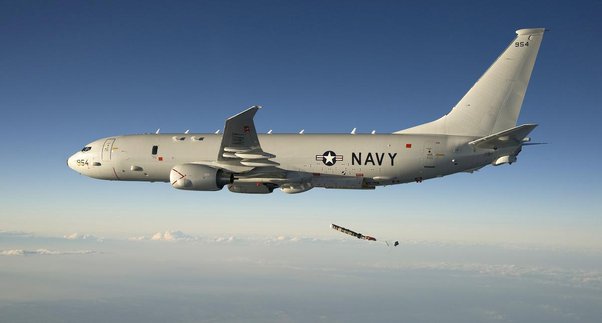
Although the US Navy continues to use the P3 Orion, they are also now using the “P8 Poseidon”, which has completely updated equipment and armaments, and is based on a Boeing 737 jet.
(Below) A Poseidon P8 dropping a torpedo; you can see the small “drogue” chute deployed off the stern of the torpedo to slow it keep its speed down when it hits the water. The Mark 54 324-millimeter lightweight torpedoes it is armed with are essentially GPS-guided glide bombs that can be dropped from altitudes as high as thirty thousand feet. These shed their wings upon hitting the water and home in on targets using onboard sonar. Poseidons can also carry Harpoon AGM-184H/K antiship missiles with a range of 150 miles.
Here’s the best answer I found for the original question. In October 2017, the US Navy placed a $219 million order for 166,500 sonobouys, among them the SSQ-53 sonobouy. Here’s what the industry whitepaper said:
The AN/SSQ-53F uses four hydrophones — each one a multichannel directional piezoelectric ceramic transducer — that operate at depths of 90, 200, 400, and 1,000 feet to listen for potentially hostile submerged enemy submarines. Aircraft can drop a pattern of sonobuoys, which relay information back to the aircraft by radio link, to determine the exact locations of enemy submarines.The SSQ-53F has three sensors: a constant shallow omni (CSO), an advanced DIFAR sensor, and a calibrated wideband omni. The buoy digitally conditions and amplifies the acoustics and provides directional data that helps establish azimuthal bearing to the submarines being tracked.
Presumably this means that these sonobouys can pick up a submarine at 1,000 feet OR deeper, because this is just the depth at which a sonobouy’s transducer is located. A transducer at 1,000 feet could conceivably pick up a sub operating a couple to a few hundred feet deeper than that. Which is pretty impressive.
Don’t mess with these bad boys!