I consider the Chinese language like a distant relative that I’ve never met before.
I’m interested and curious to know more about them since we share the same roots, but somewhat intimidated to actually do so because I hear they have a difficult personality. So instead, I stay away.
I say difficult because of mainly two reasons:
- The fact that hiragana and katakana don’t exist.
- The pronunciation that appears as if it would be nearly impossible for a non-native speaker to perfect later on in life.
Hiragana and katakana, to me, are like childhood friends among a mass of intimidating business men, some of whom I have a hard time trying to understand because they are so intelligent. The businessmen in this context are kanji.
So when I see stuff like this:
東京都中央卸売市場築地市場東京水産物部卸売業者売場
I get nervous because I don’t see a single friend. (The above is the official name of a fish dealer in Tsukiji Market, Tokyo.)
And in Chinese, there will never be any childhood friends. :'(
I would have to learn to get along with these formal business men, 24/7.
In regards to pronunciation, this is a pretty famous example known among the Japanese. In Mandarin Chinese, “ma” can have 4 different meanings based on how it is pronounced:
- mā – 媽 – mother
- má – 麻 – hemp
- mǎ – 馬 – horse
- mà – 罵 – scold
I listened to the audio here and the four are similarly confusing! I fear I would talk about my mother and everyone would wind up thinking I have a horse. Or just really love hemp.
I’ve talked to various Chinese people before and they have told me that learning Chinese would be easy (which I still refuse to believe).
However, apparently the past and future tenses are decided by context and not by conjugating verbs, meaning no complicated “go → went”, “eat → ate”, so in that sense it does seem foreigner-friendly.
In regards to deciphering meanings, whenever I see signs in Chinese, the guessing games begin.
I found it highly amusing when I saw this in Taiwan:
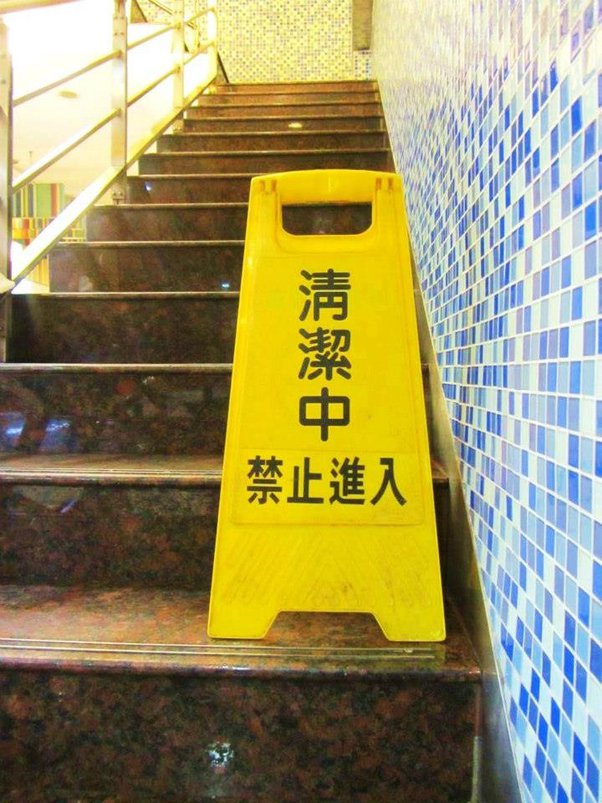
It says: “Cleaning – Entry prohibited”.
The part that says “禁止進入” or literally “prohibited to enter” can be switched and it would make perfect sense in Japanese as “進入禁止 (entry prohibited), which, may not be interesting at all to many people, but I had a serious “whaaaat” moment right there.
I love finding these kinds of minor similarities and differences. 😀
I’m also constantly amazed at how the Chinese language can assign Chinese characters to completely western names, like the below:
All in all, I think Chinese is a very practical, historical, and fascinating language, and I would love to tackle it someday in the near future.
I have many many Japanese coworkers who are Chinese language learners.
Let me share my rank of “Japanese learners’ Comments to Chinese”.
1. Suggei! Zenbu kanji! (Gosh! All characters!)
I hear this one nearly 100% when a Japanese visits China THE FIRST TIME, the first moment walking on the street of China.
Yes as everyone said, no hiragana or katagana in Chinese, all those TOUGH characters, kind of shocking.
2. mirebawakaru. kakebatujiru. (I can understand the road sign/shop names/nearly everything on the road! And I can communicate with locals by writing things down!)
Actually this is a huge benefit on both sides-Japanese people visiting China, and Chinese people visiting Japan. The similar Chinese characters work so greatly that you feel like you never crossed the country border.
3. shisei!(The four tones of Chinese)… Sigh. Such a pain in the ass.
4. You guys are crazy! You translate EVERYTHING!
There are countless gairaigo (loan words from foreign languages which are introduced into Japanese directly by SOUND, such as “restaurant”-resutoran, “TV”-terebi, not only nouns but also verbs, adjs, phrases like “case by case”-keisubaikeisu, “backup”-bakkuappu, etc) in Japanese language. While in Chinese there are A FEW too, but too few comparing to Japanese. For example, TV is called dianshi using 2 characters 电”electric” and 视 “view” which is the exact TRANSLATION. And so do “basketball”, “camera”, “computer”…nearly EVERYTHING.
And even such pitiful a few loan words, such as 巧克力(chocolate),沙发(sofa),幽默(humor), as you see, they are not written in alphabet or anything like katagana, but still in kanji characters!
My Japanese coworkers always blame “What’s the point you guys translate all the western stuffs into kanji?”
Just like we Chinese Japanese learners always wonder “How can you Japanese people remember so many totally FOREIGN WORDS like ketchup without the meaningful character like 番茄酱(tomato sauce)?”
5. This one is not a comment.
Chinese Mainlanders use simplified characters as well as Japanese people use mostly, well, kind of traditional characters (not exactly, just relatively speaking, to make long story short). So generally Chinese mainland characters are simpler than their Japanese version. Most of my Japanese coworkers can understand both versions, but once they started to write the simpler ones, they got ADDICTED to them, even in their signatures.
I understand this point SO MUCH, because…just see my company meeting note, see what a mixture of hiragana, simplified character and English alphabet…We human love easy stuff, don’t we?