The bow wave of a large ship at 30 knots is a magnificent thing unless you are an engineer. For them it represents a massive waste of energy.
You do not see tunas flapping along on the surface and there is even a rule against swimming competitively entirely under water. Porpoises have a beautiful glide just under the surface to enhance their speed.
Modern submarine shapes are optimized for under water speed and unsurpisingly look like porpoises or tunas with propellers. Modern submarines have engines that can deliver as much power underwater as on the surface.
WWII subs which had limited underwater endurance and HAD to spend most of their time in the surface had bows and shape that were poor for underwater performance but made them slightly livable sea keepers on the surface where they spent most of their time.
Surface is bad.
Dive or fly.
[addition by former MM2(SS) who worked on many of the last US diesel-electric and the early nuclear boats]
The reason early submarines were faster on the surface was not primarily hull shape. It was the engine. On the surface, they almost always used diesel engines to turn the propellers, (they tried gasoline on very early boats, with generally disastrous/fatal results) and when they had to dive, they would disengage the engines from the propellers and turn on electric motors.
Most attacks on shipping were done on the surface, using a rifled cannon, and torpedos, which were expensive, were for when they had to attack during daylight or while fighting off a counterattack by warships. They had to surface to get air for the diesels so they could recharge the batteries and clear the air inside so the men wouldn’t die from carbon dioxide buildup from their own breathing.
There was no reason to optimize the hull shape for submerged operation, as running at full speed on the batteries got you 6–7 knots instead of 3 knots, but for about 1.5 hours instead of 12 when on “reduced electrical. Later, with the snorkel (see Patrick de Bondelli’s comment below on the creation of an effective snorkel which was definitely Dutch not German ), which allowed the boat to stay submerged except for the snorkel a breathing mast, which improved the process of recharging.
After WWII, when the USA was contemplating the advantage of nuclear power and what they learned from captured German submarines, the USS Albacore was built with a teardrop shape, to see how much speed advantage it had as a diesel-electric boat.
Maximum speeds on the surface didn’t increase all that much, but submerged, even with the snorkel sticking up and pushing the boat around, it was obvious that a more than five-fold increase was possible, much faster than on the surface, as the original author of this answer noted.
Early nuclear submarines like the Nautilus SSN-571, Seadragon, etc., had hulls very similar to older boats, but this lasted only until the results of the Albacore were returned, and starting with boats like the Scorpion, Scamp, Sculpin, etc., just about every nuclear submarine of any navy adopted similar shapes, whether they went to one propeller or not.
Only the older ones (read, pre-WWII), because they were not the truly underwater ships, but rather simply a diving torpedo boats — they’ve lacked the means to spend the large time underwater, as batteries were lot less advanced than now, and these early boats couldn’t run their engines at periscope depths, which forced them to stay mostly on the surface, so their shape was optimised for surface running, and thus their submerged speed was slower than their surface speed.
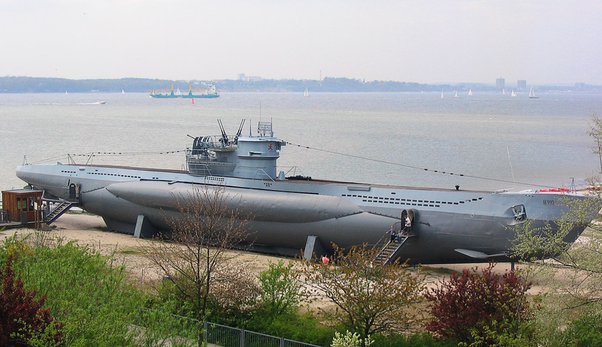
This is a German Type VII sub, a typical example of a WWII-era ocean-going sub, which looks pretty much like a normal surface ship that can dive in an emergency or for combat.
During the late WWII the Germans introduced two main innovations: better, larger, more capable batteries that allowed about twice more of the sumberged running on a full charge, and the snorkel, which allowed running the diesels and thus charging the batteries while at perscope depth. This allowed the submarines to stay submerged for much longer, and so their hull shape changed to the more suitable for the underwater running.
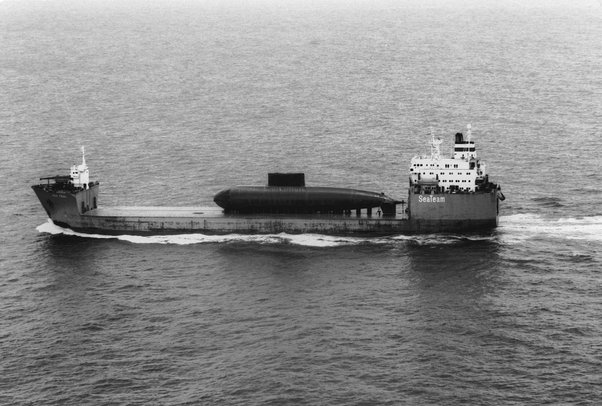
This is a Russian Kilo-class diesel sub, typical of a late Cold War-era teardrop hulls, which changed little since. Note how it looks shorter and stubbier than the earlier German sub, despite displacing about 5 times more.
After the war most of the nations quickly adopted the teardrop hulls for their submarines, even for the diesel ones, and the introduction of nuclear propulsion removed the need to stay on the surface entirely, so nowadays nuclear subs only ever surface in base or in emergency, and diesel subs try to limit surface time as much as possible. This means that they don’t need the surface-optimized hull shape, and their surfaced seakeeping is actually pretty atrocious, including the surface speed that is much slower than the submerged one.