They have tried this exactly once, to prove the viability of the concept. The Gemini 11 mission joined two capsules together with a tether and maneuvered them into a spin. It came perilously close to ending in a collision, but eventually they did manage to produce measurable artificial gravity.
.00015G.
That piddling amount demonstrates the problem with the concept that people often overlook. The approach does not scale down well at all. You need to use a very large structure to generate any kind of useful artificial gravity, and getting that structure to behave as you want it to is going to be hell.
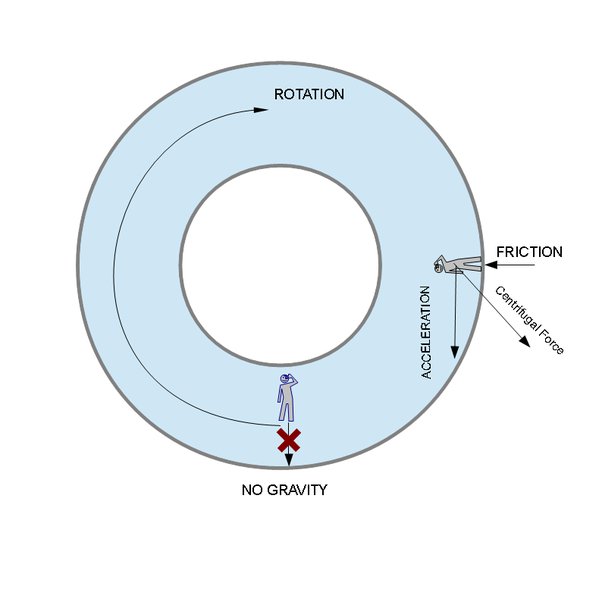
Sure, you could just spin the smaller setup faster, but that’s not going to work that well for anything manned. The coriolis effect means that the artificial gravity will seem to follow a parabolic path rather than just pulling straight down, and the small radius will mean that you’ll see a sharp gradient in how much measurable gravity there is in the craft.
Had they gotten Gemini 11 to the velocity needed to simulate 1G, the astronauts would have had all the blood in their bodies pooling at an angle because the gravity at their feet would have been so much greater than it was at their head. Imagine trying to do your taxes on a fast moving merry-go-round and you’ll get a good idea how difficult that would make life for the astronauts.
Only by using an extremely large structure with a radius best measured in kilometers can you generate a band of gravity which would be consistent enough for humans to comfortably live and work in indefinitely. We have never had anything near the heavy lift capacity to construct something of that scale.
The cost would be measured in the trillions, and by the time we finished getting the last of the required modules into orbit the original ones would already be starting to break down. The only way that such a project could make sense is after we figure out a way to harvest metals from asteroids and build the thing entirely in space.
The main reason is cost.
Building such a thing is certainly within our technological capability. Essentially the structural components would be like a suspension bridge, only instead of catenary cables supporting a more or less horizontal road surface, they would be supporting a circular structure. So material itself is not the problem.
The problem is that it takes a lot of mass to support a suspension bridge, and even if you reduce the target acceleration to some fraction of Earth gravity the result still means that you need to build a structure that has to do a lot more than merely hold in the air that the astronauts breath.
Others have mentioned the Coriolis effect, which is what you get when different parts of you standing up experience a different amount of acceleration. That’s really not such a big deal if your rotating structure is much larger than a person is tall. But for a smallish wheel it makes a big difference.
So a 20 meter (~22 yards) diameter wheel spinning at ~3 rotation per minute would produce a little over 1/10 Earth normal acceleration – for your feet. If you’re average height, then your head would experience almost 20% less acceleration – that’s like lifting a 10 pound weight over your head and finding it weighs only 8 pounds when you’re done.
To reduce that difference to a manageable amount the only option is to make the ring larger, but structural material requirements increase by the cube of the scale. A ring that’s 4 times larger requires 64 times as much material.
To appreciate that difference, consider the International Space Station. The current structure masses about 4.2E5kg (~420 tons), launched at a cost of around $18,000 per kg, or $7.5bn. Based on its stated pressurized volume, it is large enough to build something like a 10 meter donut about 2 meters thick. To increase the radius to 40 meters, the launch costs alone would be ~ $500bn. Even if new launch technologies manage to get launch costs down to ~$1,000 per kg, the cost would be almost $30bn, and that’s just for a 40m radius by 8m thick ring.
So cost is the main reason this isn’t happening. The main reason we’re sending people into orbit right now is for researching in a microgravity environment, and a spinning wheel messes that up, also it’s expensive, so why bother.