
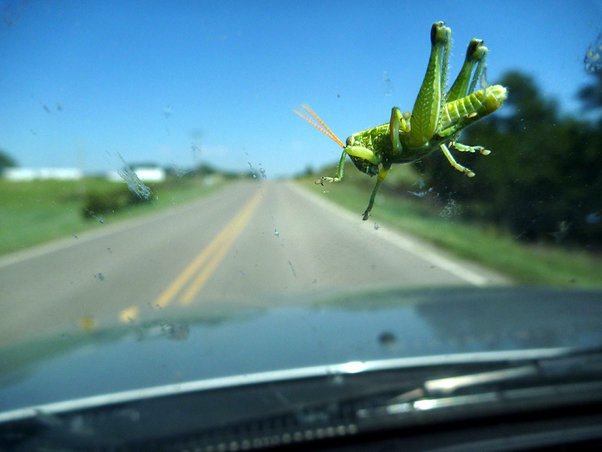
When I was a kid working in gas station, we would wash the windows of cars, while they were filling up. On warm summer nights, we would still be scrubbing the bugs off the windshield, long after the gas had clicked off.
Cars would pull in that didn’t need gas, and beg to use our windshield cleaning squeegees and sponges.
This doesn’t happen anymore. Insects are disappearing and no one knows why.
This is the windshield phenomenon.
National geographic did an article on disappearing insects. There are insect traps, that have been sitting in remote forests , in the same location for 50 years, miles from anyone, except the university researchers who go to count insects. The number of insects has plummeted drastically. Its a catastrophe. Without insects entire food chains are destroyed. No crops pollinated, no food for birds, amphibians, reptiles, shrews, etc. That means that when the frogs die off, and they are, that they animals that feed on them die off, all the way up the food chain.
This is truly a catastrophe, and no one knows about it, because all attention is focused on global warming.
Simply put, this is the observation that when you’re driving, you’ll notice that not as many dead insects will accumulate on your windshield as they used to years ago.
This doesn’t sound very scientific, but the Windshield Phenomenom actually gained traction after a 2017 large-scale study in Germany. According to the study, the presence of insects in German forests and grasslands dropped 78% between 2008 and 2017. Some species couldn’t be found at all after a few years — this accounted for an astonishing 34% fewer insect species in the areas researched (via Tree Hugger).
As scientist Wolfgang Wägele, Director of the Leibniz Institute for Animal Biodiversity, told Science Magazine, “If you talk to people, they have a gut feeling. They remember how insects used to smash on your windscreen.” Today, your windows are likely to be a lot cleaner after a long highway drive.
So scientists set up to prove the theory by creating “splatometer tests.” This was done by adding some sticky grid to the license plate of vehicles and seeing how many insects got stuck to it (per Mother Jones). A 20-year splatometer study in Denmark found an 80% decline between 1997 and 2017. A second test conducted in the UK in 2019 found a 50% reduction in impacts compared to 2004.